



Joint Venture vs Outright Sale
Which gets you more for your land in chennai?
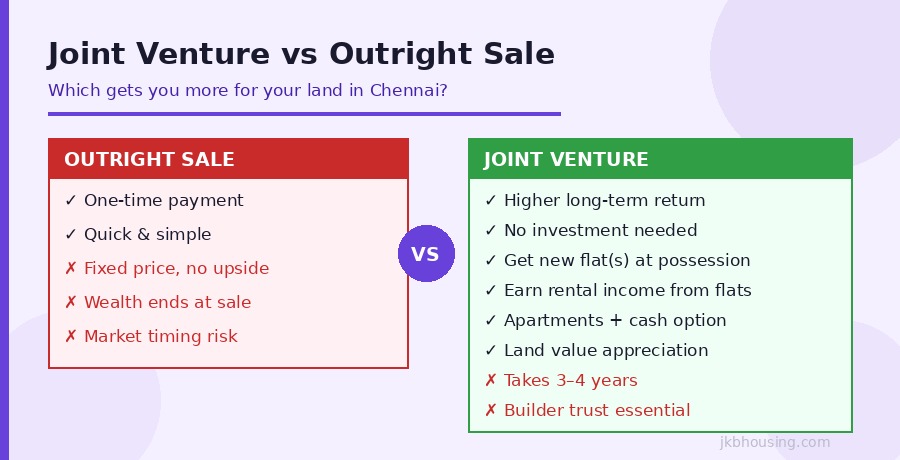
Joint Venture vs Outright Sale
Which Gets You More for Your Land in Chennai?
JKB Housing | Landowner Insights
You own land in Chennai. A builder has approached you or maybe you’ve been thinking about what to do with it for a while. Either way, you’re facing the same question that every landowner eventually faces:
Do I sell the land outright? Or do I enter a joint venture?
Both options put money in your pocket. But they work very differently in terms of how much you get, when you get it, and what you give up. If you’re exploring this for the first time, this guide will walk you through both honestly.
 OPTION A
Outright Sale — The Simpler Path
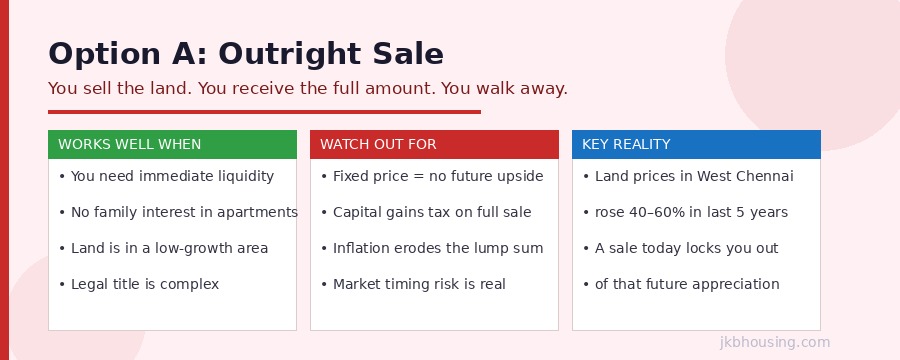
An outright sale is straightforward. You agree on a price with a buyer, a developer, an investor, or a private party and they pay you that amount in full. The land transfers to their name. Your involvement ends there.
What works well about it
- Speed. A sale can be concluded in weeks once both parties agree.
- Certainty. You know exactly what you’re receiving before you sign.
- Clean exit. No ongoing relationship with the buyer, no waiting for construction to finish.
- Useful when liquidity is the priority for medical needs, business investment, family settlement.
What you give up
- The future. Once you sell, all appreciation from that point forward belongs to the buyer.
- Upside in a rising market. Land prices in key Chennai localities like Mogappair, Kilpauk, Virugambakkam, Valasaravakkam have risen 40–60% in the last five years. An outright sale today locks you out of tomorrow’s value.
- Tax efficiency. Capital gains tax applies on the full sale value in the year of sale, which can be a significant outflow.
An outright sale gives you the floor of a guaranteed amount. A joint venture gives you a shot at the ceiling which, in a growing city like Chennai, tends to be considerably higher.
 OPTION B
Joint Venture — The Higher-Return Path
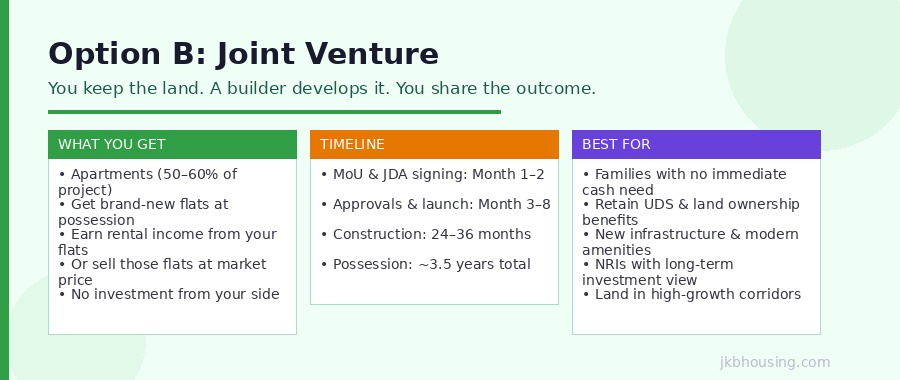
In a joint venture (also called a joint development agreement or JDA), you don’t sell your land. Instead, you partner with a builder who develops it. In return for the land, you receive a share of the developed apartments typically 50–60% of the total units built.
You can then either keep those apartments and rent them out, or sell them at market price once the project is complete. Either way, you participate in the full value the development creates not just the raw land value.
What works well about it
- Higher total return. The value of finished apartments in a good location almost always exceeds the raw land value at the time of signing.
- No upfront capital needed. You contribute land. The builder funds everything else construction, approvals, marketing, handover.
- Retained appreciation. As the project builds and the market moves, your apartments gain value even before possession.
- Tax spread. Capital gains on apartment sales can be structured over time, reducing your tax burden versus a single lump-sum sale.
- Legacy asset. You receive physical apartments an income-generating asset that can be held or sold across generations.
What to be aware of
- Timeline. A typical JV project in Chennai takes 1–2 years from MoU to possession. If you need funds immediately, this is a real constraint.
- Builder dependency. The return you receive depends entirely on how well the builder executes. This is why choosing the right partner matters more than any other decision in a JV.
- Legal complexity. A JDA requires careful drafting clear delivery timelines, penalty clauses, defined revenue shares, and a clean title verification.
JKB Housing has completed JV projects in Mogappair, Kilpauk, and Valasaravakkam delivering every landowner partner their full agreed share of apartments, on time. Our JDA process includes a mandatory title search, RERA registration before launch, and penalty clauses for delay built into every agreement.
 SIDE BY SIDE
A Real-Numbers Comparison
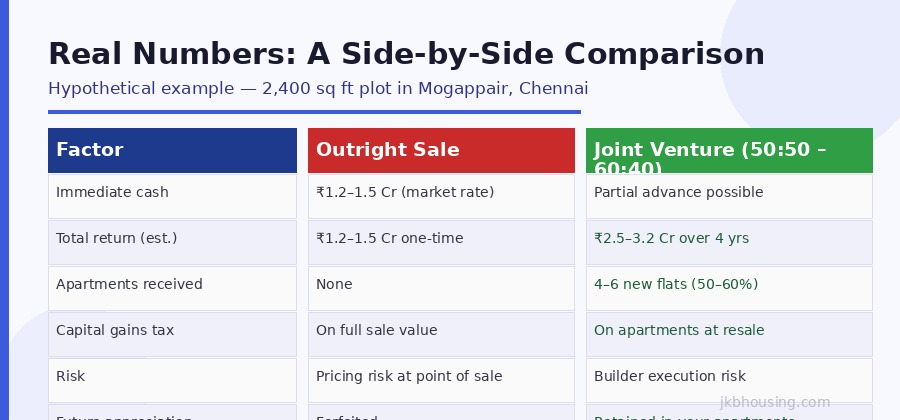
Here’s a hypothetical but realistic example a 2,400 sq ft plot in Mogappair, Chennai.
| Factor | Outright Sale | Joint Venture (30:70) |
|---|---|---|
| Immediate cash | ₹1.2–1.5 Cr (full market rate) | Advance payment possible (partial) |
| Total estimated return | ₹1.2–1.5 Cr — one time | ₹2.2–2.8 Cr over 3.5–4 years |
| Apartments received | None | 3–4 finished flats to sell / rent |
| Future land appreciation | Forfeited at point of sale | Retained — in your apartments |
| Capital gains tax | On full value, year of sale | On apartment sales — spreadable |
| Risk | Pricing risk (market timing) | Builder execution risk |
The numbers above are illustrative. Actual returns depend on location, plot size, builder quality, and market conditions. A reputable builder will share comparable project data from completed developments before you commit.
 DECISION GUIDE
So Which One Is Right for You?
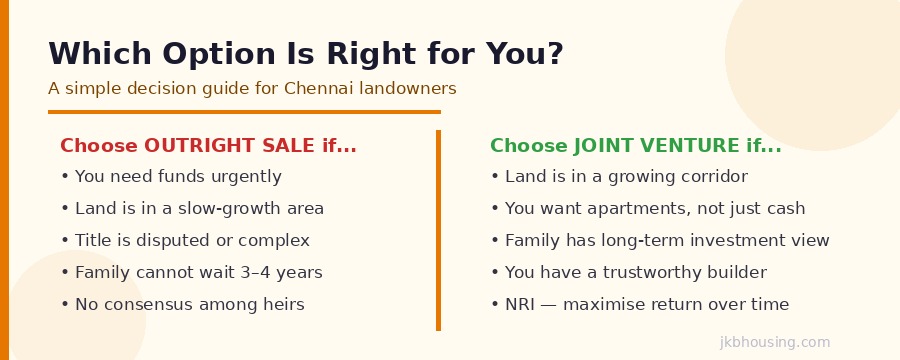
There’s no universal answer. It depends on your circumstances, your timeline, and who you’re partnering with. Here’s a honest breakdown:
|
Choose Outright Sale if…
|
Choose Joint Venture if…
|
A note for NRI landowners
If you hold inherited land in Chennai and live abroad, a joint venture often makes more sense than an outright sale especially if you don’t need immediate liquidity. The apartments you receive can either be sold after possession (capital gains tax rules apply) or rented out through a property management arrangement, creating ongoing income from an asset that would otherwise sit idle.
The key is ensuring your Power of Attorney holder and your lawyer are both involved from the MoU stage, not just at registration.
The Decision Comes Down to One Thing
Both outright sale and joint venture can be the right choice depending on your situation. The outright sale is simpler and faster. The joint venture is more complex but typically delivers a significantly better return for land in a growing market.
What makes the difference in a JV isn’t the ratio. It’s the builder. A developer who has done this before, who registers the project under RERA, who puts penalty clauses in the agreement, and who has landowner references you can actually call that builder turns a promising JDA into a result you’re proud of.
At JKB Housing, we have partnered with landowners across West Chennai for over two decades. If you’d like to understand what a JV with JKB would look like for your land the numbers, the timeline, the ratio we’re happy to walk you through it with no obligation and no pressure.
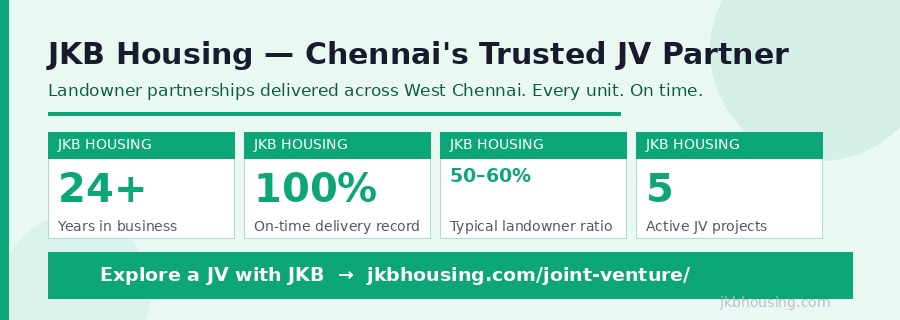
24 years. 100% on-time delivery. Every landowner partner received exactly what was agreed — in writing.
JKB Housing is a Chennai-based residential developer with over two decades of joint venture experience. Your land. Our execution. A result you can count on.



 Sales
Sales